
The department of commerce has urged the agriculture ministry as well as the diplomatic mission in Tehran to apprise it of details as to why Iranian buyers have stopped import of rice and tea from India, a senior government official said. Exporters said that exports of items such as high quality tea and rice have stopped since last week. As of now, there has been no confirmation from the authorities and the response from the embassy in Tehran is also taking time, they said.
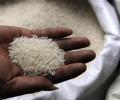
China has started importing Indian rice after a gap of two years and placed orders for the shipment of about 5,000 tonnes of non-basmati rice due to competitive prices offered by India compared to other nations, the All India Rice Exporters Association said.
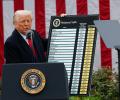
The official said there are both challenges and opportunities for India as many of its competitor countries in exports, such as China Vietnam, Bangladesh, Cambodia and Thailand, face higher duties.

The Congress party has criticized Prime Minister Narendra Modi's handling of GST reforms, calling them inadequate and demanding an apology for the tax imposed on essential items. They argue that the reforms are merely a 'band-aid' solution and that the government should address the states' demand for extended compensation.
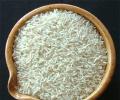
Basmati exports may dip due to the increased competition posed by Pakistan.

Finding solutions to address non-tariff barriers would be important for the proposed free trade agreement (FTA) between India and the European Union (EU) and both sides are actively working on resolving these issues, Commerce and Industry Minister Piyush Goyal said on Thursday. He said the two sides are "pretty" close to finalising the talks for the proposed free trade pact.

'I can sanction projects worth Rs 20 trillion annually as of today.' 'But my system is only capable of executing projects worth Rs 3 trillion to Rs 4 trillion.'

With satisfactory progress of monsoon rainfalls prompting farmers to bring in additional area under basmati sowing, prices are set to fall lower going forward.
India's policy for agriculture trade must move commodity-by-commodity to gain maximum benefits as US President Donald Trump's 26 per cent tariff on exports from the country take effect, said agriculture economist Ashok Gulati in a recent policy paper.
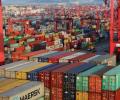
India's exports registered a steepest decline in 13-month falling 9.3 per cent in August to $34.71 billion due to global economic uncertainties, while the trade deficit soared to a 10-month of $29.65 billion. According to the government data released on Tuesday, imports increased by 3.3 per cent to $64.36 billion, which is a record high, due to a significant jump in the inbound shipments of gold and silver.

A new study by IIT-Kharagpur warns that ozone pollution could significantly reduce agricultural yields in India, particularly impacting wheat, rice, and maize production. The study, published in the journal 'Environmental Research', highlights the vulnerability of major food crops to rising surface ozone levels, especially in the Indo-Gangetic Plain and Central India. The researchers call for effective emission reduction strategies to mitigate these risks and ensure global food security.
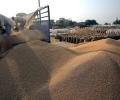
T Nanda Kumar, former food and agriculture secretary, shared his memories of working with former prime minister Manmohan Singh during some of India's most challenging times, highlighting Singh's compassionate leadership and commitment to ensuring food security for all Indians. Kumar recalled Singh's steadfast support during the 2008 global food crisis, where he championed a ban on non-basmati rice exports to secure domestic supplies. Singh's leadership, characterized by intellect and humility, left a lasting impression on Kumar, who considered him a mentor and guiding light.

Seventy years after Pather Panchali released on August 26, 1955, we finally get it. Shuttling between the village of Boral and a studio in Calcutta, caught between worrying about the next purse of funds and wondering which item to mortgage next, Satyajit Ray was explaining Indians to themselves, discovers Sreehari Nair.

Buffalo meat exporters faced supply problems due to the Centre's ban on animal sales

Rice prices surged to a fresh 34-year high on Tuesday as the Philippines awarded a tender for the staple at an average price of $708 a tonne, up almost 50 per cent from the price it paid in late January. The sharp rise reflects a market suffering from tightening supply after key producers India and Vietnam this month both imposed further restrictions on rice exports. Supplies from Thailand are also low, traders said.
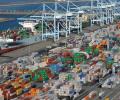
After remaining in the positive zone for three months, India's exports contracted 1.2 per cent to $33.98 billion in July, while the trade deficit widened to $23.5 billion.

The US is expected to push for sweeping changes in India's policies, ranging from tariff reductions to regulatory overhauls, that could benefit American firms and exporters, under the proposed bilateral trade agreement with India, think tank GTRI said on Sunday.

The Indian government has assured citizens that the country has ample food stocks to meet domestic demand, despite escalating tensions with Pakistan. The government has also warned traders against hoarding essential food items and creating artificial shortages, emphasizing that there is no need for panic buying. The food ministry detailed the country's current stock levels, showcasing a surplus over required buffer norms for rice, wheat, and pulses. Additionally, India holds substantial edible oil and sugar stocks, ensuring a strong food security position.
Strengthening of rupee has made Indian rice dearer in the international market
Nearly six months after New Delhi and Beijing signed a protocol to facilitate the export of Indian basmati rice to China, rice exporters are here in an upbeat mood.
India's share in the world market for basmati rice is about 53 per cent, said the government on Friday.

After a strong run in the midcap and smallcap indices, which surged 46 per cent and 43 per cent, respectively, on the National Stock Exchange (NSE) during Samvat 2080, analysts suggest that the rally in these segments may pause to catch its breath in Samvat 2081.

The commerce ministry is working on different scenarios to assess the possible fallout of reciprocal tariffs to be imposed by the US administration on April 2 on its key trading partners including India, sources said. US President Donald Trump has said that April 2 will be 'Liberation Day' as he plans to announce tariffs or import duties to bring down America's trade deficit, and promote the country's manufacturing.

Top government officials in New Delhi have started discussions with stakeholders ranging from shipping and container companies to export promotion councils to understand the impact of the Iran-Israel tensions and plan ahead. Inter-ministerial talks are also being lined up amid the crisis situation in West Asia, sources confirmed. While the crude flows are not directly under any threat, elevated oil prices remain a concern, according to officials.
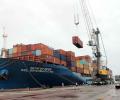
Industry associations and companies in the United States, including the US Chamber of Commerce, Coalition of Services Industries and the iconic bike company Harley Davidson have called on the Donald Trump dispensation to push India to reduce tariffs, non-tariffs, and regulatory barriers to boost American exports.
The government said on Monday that it would continue to allow exports of rice, wheat and wheat products without quantitative restrictions as long as there were enough stocks for domestic consumption.\n\n
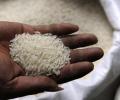
A 6-7 million tonnes shortfall in rice production due to a fall in paddy sowing area is likely to keep rice prices at elevated levels, adding to the inflationary pressure that the slowing economy is already grappling with. Elevated food prices, including that of cereals, had led to retail inflation reversing a three-month declining trend, to touch 7 per cent in August. Similarly, the wholesale price inflation, which declined to 11-month low, also showed price pressures from cereals resulting from wheat output being impacted by severe heat waves in some parts of the country.

Govt uneasy at prices, availability for domestic consumption.
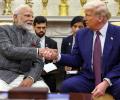
'President Trump believes in reciprocity and it is about time that we have a president who actually looks out for the interests of American businesses and workers'
The ongoing tussle between Indian and Pakistan over patenting of super Basmati rice will, in no way, will not hamper India's export potential, said Veetee Fine Foods Ltd CEO Aayushman Gupta in Kolkata.
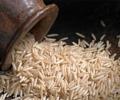
Following the outbreak, Iran has stopped Indian basmati shipments. This has led to exports already falling 18-20 per cent this fiscal year. Iran and the rest of West Asia account for the largest imports of Indian basmati, and comprise more than 30 per cent of the shipments.

A closer look at the data reveals that a lot of the items are not part of this calculation. The notable ones include buffalo meat, marine exports, raw cotton, and plantation crops such as tea, coffee, rubber, etc.

The White House has said India imposes a 100% tariff on American agricultural products and the high levies charged by other countries make it "virtually impossible" for US products to be exported to those nations. President Donald Trump has repeatedly criticised the high tariffs charged by India and other countries on American goods. He plans to roll out a set of reciprocal tariffs on April 2, which he says will be "Liberation Day" for the US.
Lower crop and high prices have hit basmati rice exports but some buying is likely in the near term as traders expect prices to soften.
Take the Rediff Business Quiz and see how much you know about some of the worlds' leading exporters and manufacturers.
The production of oilseeds is characterized by low yields and hovering around 280-300 lakh tonnes only.

Increased production of pulses, oilseeds, and cereals will help boost domestic supplies and contribute to keeping inflation low in the coming months.
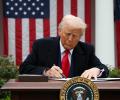
On India, the chart showed that the country charged 52 per cent tariffs on the US "including currency manipulation and trade barriers," and America will now charge India "discounted reciprocal tariffs" of 26 per cent.

It is also stipulated that these units cannot under any circumstances source items locally for export purpose.
 © 2026 Rediff.com - Advertise with us - Disclaimer - Privacy Policy - Sitemap - Feedback - About us - Terms of use - Grievances